Monday, April 16, 2018

Apple Pie From Scratch

Mom Mom Jessie as a newlywed 
My husband's sweet grandmother Mom Mom Jessie passed away last month at the age of 97.  Jessie was the oldest of eight siblings, born in 1921 to a huge farm family that grew just about everything in the rich soil of southern New Jersey. Being the oldest. she was her mother's right hand and learned how to run the household, care for her brothers and sisters and, of course, cook. She married a south Jersey farm boy and they raised two kids, passing her love of simple and wholesome cooking down to future generations. Mom Mom learned to make everything from scratch by hand without the benefit of fancy kitchen gadgets and electronics. She pickled, she made jam, she preserved vegetables and she baked. At her funeral, praises were sung over and over about Mom Mom's pies. My husband has always raved about Mom Mom's pies and he speaks with loving nostalgia about her sour cherry pie made with cherries from her brother's farm. So I set out to follow her lead and make a pie from scratch.

Not long after my husband and I got engaged, we were talking to Mom Mom on the phone and I asked her to share her tips for making pie crust. I'd recently had a failed attempt and I was sure she had some farm wisdom that would set me on the right path. Mom Mom's answer was totally not what I expected. "To be honest, I haven't made a pie crust in years", she said, "my secret is Pillsbury. Its so much easier and tastes just fine".  She laughed sheepishly. Mom Mom didn't realize it at the time, but her comment gave me permission to be lazy all these years and not learn how to make my own pie crust. Its high time I mastered this most basic kitchen skill.

APPLE PIE

Pie crust:
2 1/2 cups all purpose flour
1 tbsp sugar
1 tsp salt
2 sticks (8 oz) unsalted butter, cut into cubes and very cold.
6-7 tbsp ice water

Filling:
6 apples, peeled, cored and sliced thinly
1/4 cup dark brown sugar
2 tbsp good quality honey or maple syrup
2 tbsp all purpose flour
1 tbsp corn starch
1 tsp cinnamon
zest of one large lemon
juice from half a lemon

There is nothing quite as satisfying as a well made apple pie. My mother made a lot of apple pies when I was growing up. It was standard fare on every holiday table and while I helped her many times, I couldn't tell you how she made the crust. There something daunting and mysterious about pie crust and the one time I tried to make it myself, I overworked it and it was tough and bland. Its not terribly difficult, but there are several variables and a lot can go wrong with the smallest mistakes. The proportions of fat to flour, the temperature of the ingredients, the moisture content and the way the dough is made can all have profound affects on the final product. A good pie crust should be tender, flaky and have a rich, buttery flavor.

My research started with my go-to source for all baking knowledge - Baking With Julia - the companion book to Julia Child's wonderful PBS series. Julia's basic pie dough recipe called for a mixture of butter and shortening, explaining that shortening yields a flakier crust, but butter brings the flavor. This is because shortening has more water in it, which evaporates during baking and creates that distinctive flaky texture. Butter has less water and creates a more crumbly crust with tons of flavor. Also, the fat needs to be ice cold so it stays in small pieces as the dough comes together. Those small pieces of fat melt during baking and the water evaporates, leaving an air pocket in the crust, which gives it that flaky texture. If the fat gets too warm, it melts and disintegrates into the flour, leaving no air pockets and no flaky texture. I didn't happen to have shortening in my pantry, but I did have 2 sticks of Amish rolled butter with 84% butterfat. I cut them into large chunks and put them on a plate in the freezer to get them well chilled while I measured out the rest of my ingredients.

I measured my dry ingredients directly into the bowl of the food processor fitted with the blade attachment, pulsing a few times to sift them together before adding the cold cubes of butter. I pulsed the food processor until the mixture resembled course cornmeal and there were still quite a few largish chunks of butter remaining. One tablespoon at a time, I added ice water and pulsed the processor until the mixture just started the come together, but hadn't yet formed a ball. I took a small handful of the dough, squeezed it in my hand and it held together. The dough had a crumbly texture, but once it was turned out onto my work surface, it came together into a mass. One of the classic mistakes you can make with pie dough is to overwork it, which results in a tough, hard crust. This dough should not be kneaded and requires at least an hour to rest and chill in the fridge before it gets rolled out. I split the dough in half, worked each half into a rough ball and transferred it to a sheet of plastic wrap, which I used to press and shape the dough into a smooth and evenly round disk. With my pie dough chillin' in the fridge, I turned my attention to the apples.

The variety of apple you use makes a tremendous difference in the flavor and texture of the pie. Some varieties like Red Delicious and Rome become mushy when they are cooked. Cooking can also change the flavor, causing some apples to become too sweet or just bland. Granny Smith apples are known for keeping their shape when they cook, but they are very tart. A mixture of different varieties will result in the best flavor and texture. I chose a combination of Granny Smith, Macintosh and Gala apples, which I peeled, cored and sliced very thinly. I added all the other ingredients to the apples and set them aside to macerate in their own juices and soften before baking.

After about 2 hours in the fridge, the pie dough was firm, rested and ready to rock. I left it sitting on the counter for about 20 minutes so it could warm up just a bit before I started rolling it out. I also set my oven to 375 so I could blind bake the bottom crust. Blink baking is a technique where you pre-bake the bottom crust to make sure it stays crispy as you bake your pie. My mother never blind baked her pie crusts and the bottom was always floppy, doughy and under-cooked. For most of my life, I thought that's how all pies were supposed to taste because that was all I knew, but when I experienced a well-baked pie crust for the first time, I knew there was room for improvement in my mother's technique. Now, I never bake a fruit pie without blind baking the crust. I unwrapped one piece of dough and started working it a bit with my hands.
It was a really stiff dough that still had kind of a crumbly texture and it was not an easy task to roll it out into a somewhat circular shape. It kept cracking around the edges and I had to roll the edges together and pinch them as I went to keep the dough together in a single piece. It was also pretty sticky and I had to flour the surface and flip the dough quite a few times to keep it from sticking to the table. But I finally managed to get it rolled out and into the pie plate. I trimmed the edges, built the dough up to make a nice border and placed it in the fridge to firm up for 15 minutes before blink baking. When it was chilled, I poked little holes all over the bottom of the dough to allow steam to escape as it bakes, which keeps it from bubbling up, then placed a sheet of parchment into the center of the crust and filled it with beans. I keep a jar of beans in my pantry that I only use for this purpose. The beans act as weights that keep the crust flat and prevent it from sliding down into the pie plate as it bakes. After 20 minutes in a 375 degree oven, the edges of the crust had just started to brown and I removed it from the oven and let it cool down while I rolled out the top crust. I also turned the oven down to 325, which is the perfect temperature to bake the pie long enough for the apples to cook without burning the crust.

Since it had been out of the fridge for about an hour, the top crust was a little easier to roll out. I managed to get it pretty thin and by the time I was done, the bottom crust had cooled enough to work with. I poured all the apples into bottom crust and gingerly draped the top crust over the apples. I cut the edges of the dough off so they were even with the border, but there was a gap between the partially baked bottom crust and the raw top crust. So I gathered up all the scraps of dough, formed them into a ball and I rolled it into a long, thin rope, which I used to encase the outside of the border of the bottom crust, bringing the raw top crust over it and crimping the edges with my fingers. It looked pretty nice, actually, and I was proud of my ability to solve a problem quickly with scraps of dough. Before I put it in the oven, I carved a heart into the center of the top crust to allow the filling to vent as it cooked. Then I painted the entire pie with a beaten egg and sprinkled the top liberally with Demerara sugar. If you don't have this light brown sugar in large crystals in your pantry, I strongly suggest you get some. It is perfect for topping pies, cakes, cookies and muffins and yields a crunchy, sweet exterior to any baked item.


The pie needs at least an hour to bake and it should be placed on a baking sheet to make sure any juices that run out don't drip onto the bottom of your oven and burn. The pie is done when you can see the juices bubbling under the air vents you cut into the top crust. Some juices will probably leak out into the center of the pie and that's just fine. I took my perfectly browned pie out of the oven and set it on the counter to cool. An hour later, I sliced a piece for both my husband and myself and added a small scoop of vanilla ice cream on the side. Its hard to accurately describe how scrumptious this pie truly was. The fruit was perfectly cooked with lots of visible slices of apple that still had some texture. Because of the combo of flour and corn starch in the filling, the juices had thickened up nicely and were slightly viscous without being gooey or gummy. The bottom crust was cooked through and slightly browned, just as it should be. Overall, the crust was delicate and tender and had a crumbly texture, almost like shortbread, with a strong buttery flavor. It was absolutely divine. I figure the best way to honor Mom Mom's memory is to cook like she did, with the freshest ingredients, a little common sense and a lot of love. I think she would have been proud of this apple pie. Cheers to you, Mom Mom, wherever you are.


Sunday, April 8, 2018

Pizza Party


I think I have respectable skills in the kitchen, but there are many types of food I just do not know how to make, nor am I likely to attempt them at home. I love Indian food, but don't have enough experience cooking it to do it right. My baking skills are good, but I have yet to take on challenging things like puff pastry. I've never made pho. All these cuisines are available at restaurants, where they are made by people who know those flavors and techniques inside and out, certainly much better than I do. Even though I know its quite easy to make, until recently pizza was one of those foods for me.

I sit on the board of directors of a very cool theater company here in Pittsburgh called Bricolage Production Company. A couple years ago, I offered to host a dinner party at my home with the company's founders as a silent auction item for their annual fundraising event. It was an elaborate dinner; we made pasta by hand, we made our own pesto with herbs from our gardens and we made ice cream from scratch. The folks who had the winning bid in the auction were wonderful people and it was a tremendously fun night, but it was a ton of work and took us hours to prepare. We were all completely exhausted at the end of the night. When it came time to plan the fundraiser last year, we decided to do something much less complicated and after a little brainstorming, we settled on an Oscar night pizza party. I have a nice, big den with a gas-jet fireplace and a huge, comfortable couch where we could watch the Academy Awards presentation. Plus, I've never made pizza at home before!

Tami Dixon at work
Tami Dixon and Jeffrey Carpenter, the founders of Bricolage, are warm, smart, highly intelligent and really fun people and Tami loves to cook. My job was to have appetizers and desserts ready and Tami was in charge of the pizza and salad. By the time the Bricolage gang arrived, the house was spotless, my favorite chocolate blackout cake was chilling in the fridge and there was a lovely spread of cheeses, fruit, crackers, olives and yummy deviled eggs with just a touch of horseradish in the filling. Tami immediately jumped in and started making the dough. She was using yeast that was specifically made for pizza dough, which means that the dough doesn't need to proof before baking. She also used jarred pizza sauce and pre-shredded Italian cheeses as well as a variety of fresh toppings, which tasted great and saved a ton of time. The result was absolutely delicious and I was surprised at how good and how simple it was to make. Tami made about 6 different pizzas and we had an amazing feast and a wonderful evening watching the Oscars together.

Tami's mushroom pizza
Over the next couple of days, I found myself thinking about that pizza. The following weekend I decided to make an enormous pot of slow-cooked spaghetti sauce with meatballs and sausage. Its one of my favorite Sunday dinners because it rewards me meal after meal with things like lasagna, meatball sandwiches, shakshuka and, of course, pizza. In the past, I would buy a pre-made crust, but not this time.


PIZZA DOUGH

3 1/2 to 4 cups bread flour
1 tsp sugar or honey
1 packet instant dry yeast
2 teaspoons salt
2 tablespoons olive oil

As usual, I did a little research before I proceeded and settled on a basic recipe I saw multiple times. Making pizza dough at home is easier than falling off a log and if you've worked with any kind of yeast dough before, this is a breeze. I combined all the ingredients in my stand mixer and using the dough hook, mixed until the dough came together into a ball. I kneaded it for about 5 minutes in the mixer, then turned it out onto my counter and kneaded it by hand until it was nice and smooth and stretchy. I gave this dough an hour-long proof in an oiled bowl and allowed it to just about double in size. At this point, the dough can be used to make pizza, but I wanted to see what happened if I let it proof overnight in the fridge. According to everything I read, the longer it sits in the fridge, the more flavor the dough develops.

A bit about equipment - there are different ways to make pizza. It can be baked in a pan, on a cookie sheet or straight on a pizza stone. I had a pizza stone for a long time, but it eventually cracked and I just haven't replaced it yet. If you are using a pizza stone, you will need a peel to get your pizza in and out of the oven. Also, the familiar technique of flipping pizza dough in the air until its paper thin provides great theatrics, but its impractical for a home cook. Tami used a rolling pin and so did I. The dough is very stretchy and tends to shrink back as you work with it. If you let it rest for a few minutes as you're working it, the gluten will relax a bit and it will be easier to roll. 

I cut about a quarter of the dough off so I could make a test pizza before putting the rest of the dough into an oiled ziplock bag and setting in the refrigerator. I rolled that small dough ball out with a rolling pin until it was very thin, then laid it into an oiled baking pan. I cranked the oven to 450 degrees and while it pre-heated, the yeast in the dough reactivated. By the time the oven was ready, the dough had just begun to puff up. I popped it into the oven for just 5 minutes so the crust could set a bit before I put the sauce and toppings on it. A thin layer of sauce followed by handfuls of grated mozzerella and parmesan cheeses went on before I put it back in to finish baking. About 10 minutes later, I pulled a beautifully bubbling pizza with a golden, crispy crust out of the oven and was pretty pleased with my effort. The pizza was tasty with a toothsome, crunchy crust. The next day, I used the rest of the dough and filled the biggest baking pan I own to make a giant pizza. It was even more delicious and we ate the leftovers cold right out of the fridge for two more days. It was the gift that kept on giving. I'll be making my own pizza dough from now on so any day can become a pizza party!


Saturday, March 24, 2018

A Pile of Pierogies


Last month at our inaugural Bitchin' In The Kitchen gathering, a group of 5 bawdy women in our 50's made challah, drank wine and laughed our asses off at my house. As we shared ideas about the second meet-up, Suzanne offered to host and suggested we make pierogies. Who doesn't love pierogies?! We all jumped at the chance to roll some dough, enjoy an adult beverage and eat freshly made pierogies with a group of fantastic women.

Pierogi is the national dish of Poland and is somewhat of a generic term for a filled dumpling. They can be filled with ground meat, sauerkraut, the classic potato & cheese combo or even fruit for a tasty little dessert or afternoon snack. The origin of this dish is unclear, but its been around since at least the 1200's and it's called by many different different names in eastern European cultures. They show up on Slovakian, Hungarian, Romanian, Russian and German tables, but they are such an important and beloved part of Polish culture that every holiday has its own type of pierogi. Pittsburgh has had a love affair with the pierogi since the Industrial Revolution, when a huge eastern European workforce brought their traditions to the region. Pierogies are so popular here that in the 5th inning break of Pittsburgh Pirates games, people dressed in giant pierogi costumes race each other around the outfield. I usually root for Jalapeno Hannah.


PIEROGIES


For the dough

3 c all purpose flour
1 tsp salt (1 tsp garlic salt optional)
3/4 c melted butter
3/4 c water
1 egg

For the filling

2 lbs Russet potatoes
2 c grated sharp cheddar cheese
1 medium onion, chopped and caramelized in butter
Salt and pepper to taste

Making pierogies from scratch is a real commitment. This is not something you whip up 
on a weeknight when you get home from work. These dumplings were traditionally made by large groups of women for big gatherings like weddings and holidays. Depending on the size of the cutter, this recipe makes 40 to 50 periogies, which is enough to serve about six people. Its hardly worth the effort for a few portions and since there were four of us bitchin' in the kitchen, Suzanne was prepared for a large scale production.


Using a couple of different recipes for guidance, Suzanne, Lynn and Marie had boiled six pounds of potatoes, letting them cool slightly before mixing in four cups of grated cheese, two large sauteed onions and salt and pepper in the stand mixer. While the filling cooled, they made small batches of two different dough recipes - one with egg and one without. I arrived a couple hours late and when I walked in the door, they handed me a matching apron, a delicious adult beverage and a small plate with two pierogies on it, one from each batch of dough. With just a little bit of salt and butter, they were both delicious and I wanted to eat 7 more, but we had work to do. The dough with the egg in it had a pleasant toothsome texture while the eggless dough was slightly gummy. We all agreed that the dough with egg was superior in taste and texture, so Suzanne started making a second batch of dough. Pierogie production had begun! 

To make the dough, Suzanne put the water and butter in a small pot on the stove and gently heated them until the butter melted. She put the flour and seasoning in the bowl of the stand mixer and using the dough hook, she blended in the water until the dough started to come together. Finally, she added the egg and kneaded the dough until it had a slightly sticky, slightly elastic texture and felt almost like a pasta dough, which took about 5 minutes.


We set up an assembly line with Suzanne rolling the dough very thinly and cutting it into rounds. She didn't have a pastry or biscuit cutter, so she was using a cocktail shaker to cut the dough. Lynn filled each round with a couple tablespoons of filling, Marie dampened the edges of the dough with a little water and sealed each pierogie and I was at the end of the line with a fork crimping the edges and filling tray after tray with beautiful, handmade dumplings. After four hours, we'd made 5 batches of dough and ended up with about 250 pierogies.


Finally, Suzanne boiled some water while Marie sauteed onions in butter until they were a deep, golden brown. Suzanne dropped a dozen pierogies into the pot and boiled them just until they floated. Using a slotted spoon, she fished them out and dropped them into the pan with the onions and added another generous nub of butter. Our reward was at hand and we sampled our handiwork with a great sense of pride. My oh my, those little pillows of joy were tender and chewy and just delightful and we each took home an enormous ziplock bag of pierogies. To freeze these little beauties, lay them out on a sheet tray covered with a piece of parchment paper or waxed paper and place the tray in the freezer for about half an hour. Once the pierogies are frozen they can be put in bags and kept for months in the freezer.  It looks like our next Bitchin' in the Kitchen gathering will take place at Lynn's house and she's planning to have us make ravioli, the Italian version of pierogies, another large scale production. I sense a pattern developing here. 


Sunday, March 11, 2018

My Favorite Store Is Closing

My favorite grocery store in Pittsburgh is closing its doors. After more than 70 years in the business, family owned McGinnis Sisters will cease operations as soon as their inventory is gone. I made one last trip a few days after the announcement and it was a really emotional experience. The folks I'd relied on for fresh fish, locally raised meats and produce and a kick-ass bakery were packing it up and preparing to walk away from a community institution. The produce guy commiserated with me and made some suggestions for where I might find the same kind of quality items that McGinnis Sisters stocks. A woman in the deli expressed her fears to me about finding a new job after working there for 42 years. The guys at the meat counter who saw me every couple of weeks were too sad to even meet my gaze, let alone engage in small talk. As I walked past the empty produce bins, empty fish counter and abandoned bakery, I thought a lot about why I love this grocery store so much and what is has in common with the other small, family-owned stored I've loved in the past.

When I lived in Texas, small, family owned stores were a little harder to find, but in its early years Whole Foods, which started in Austin, Texas, very much fit the bill for me in terms of selection and quality. I lived in Philadelphia for a year and was pleased to find small grocery stores and food co-ops everywhere. The Italian market in my neighborhood had incredible meats, cheeses and specialty items. When we moved to New Hampshire, the closest Whole Foods and the wonderful Lebanon food co-op were an hour away and I'd make the trip every couple of months, but my weekly food shopping always included a stop at Quality Cash for meat. It was owned by a guy who'd spent 20 years working for large grocery chains and he made the commitment to carry the very best quality chicken, lamb, beef and smoked meats from small producers in the region. When I found McGinnis Sister shortly after moving to Pittsburgh, it felt just as familiar and welcoming as the places I'd loved before.   

There are a set of characteristics that, for me, define a great food store. Some of them are obvious, such as the ability to stock local products and keen attention to quality, but there are other things that combine to make for a pleasant grocery experience. How the store is laid out, how the inventory is displayed, how things are priced and how much is made and/or packed in-house are all important considerations. My favorite small grocery stores all have their unique specialties. The Italian market I loved in Philadelphia had outstanding meats with a great selection of exotic cuts like fresh duck breasts and veal shank. They had a small but excellent deli and a small produce section with enough to make a nice salad or fresh green side dish. Quality Cash focused much of their attention on their chicken, meats and lunch counter. Their chicken came from a specific producer in Salisbury, MD and was air chilled, never frozen and was the best tasting chicken I've ever prepared. They carried extremely good beef and lamb, some raised locally and some from other producers in the region, and their lunch business was very active with an in-house kitchen that served pulled pork, fried chicken, sausage sandwiches and lovely breakfast sandwiches. I've also shopped at a wonderful family owned Italian market here in Pittsburgh called Labriola's, which has awesome imported deli meats, sausages, really good prepared classic Italian dishes and all the imported pasta, canned tomato products and olive oil your little heart could desire. These places are all modest businesses, occupying maybe 3000 square feet in a small shopping center or in a stand-alone building no bigger than a large single family home. These are the kinds of places that are crowded when 20 or 30 customers are shopping at once.

McGinnis Sisters locations were more the size of small supermarkets at maybe 10,000 square feet, but in many ways had the same vibe as my favorite small stores. Much of their seasonal produce had signs indicating which farm or town they came from. Their selection of apples was second to none and when they were in peak season, I would walk out with varieties such as Stayman, Idared or ginger gold, all grown within a 100 mile radius. Not all of their produce was local, but there was enough of it to make me happy. The same was true for their meat department with beef, chicken, turkey and pork all coming from regional producers and for not much more money than I'd spend at a big box supermarket, I regularly stocked up on fresh ground beef, pork tenderloins and the very best chicken wings I've ever cooked. Every Friday, the fish department received fresh Alaskan salmon, Atlantic cod or scallops from New England. Its the only place I've ever found fresh skate wing. McGinnis Sisters bakery featured the most scrumptious pepperoni rolls, small loaves of ciabatta and sourdough bread and amazing pastries, cookies, pies and cakes, all made right in plain site of the general public. They also had a nice cheese case and a good selection of fresh eggs, Amish butter and local dairy products. When it came to general staples, dry goods and pantry items, McGinnis Sister honored the European roots of the population and the shelves were graced with exotic types of mustard, condiments, jams and canned goods, plus a small but mighty selection of chocolates and sweets that beckoned as I stood in line at the register. It wasn't a huge store, but it was big enough to stock an interesting variety of stuff and no matter how many times I've shopped there, something unique usually caught my eye.

While there are advantages to shopping at smaller local chains and mom & pop stores, there are drawbacks. Many of them don't carry everything on your grocery list or if they do, the prices are unreasonable. I can't buy toothpaste, cleaning supplies or cat litter at most of my favorites places, so I do end up making several stops on my weekly run for supplies. I certainly spend more money when I make multiple stops and while I found McGinnis Sisters produce and meats to be priced competitively, a lot of their other items were much higher than they are at the big chains. That said, I'm willing to make that choice so I can feel good about what I'm putting in my body and where I spend my money on the foodstuffs I desire. However, I realize this lifestyle isn't for everyone. During a recent conversation with some of my colleagues, it was surprising to discover how many people despise their regular trips to the supermarket. They were raving about the convenience of ordering online and having someone bring their haul right to their car or even just shipped directly to their house. The world has changed and it has become increasingly more difficult for small businesses to compete in the everything-at-your-fingertips marketplace we live in. The personal touch isn't as valued as it once was.

Ultimately, that's what I will miss most about McGinnis Sisters - the people. The guy who ran the fish counter never steered me wrong, I was always pleased with his recommendations, even his advice on cooking methods. The guys in the meat department and the women in the bakery were always kind and attentive. The checkers were pleasant and engaged. I never saw employees standing around playing with their phones or chattering with each other as if the customers didn't exist. They were genuinely happy to serve me. They cared. They cared enough about their customers to be responsive, to give them the very best and to regard their own business as an integral part of the communities they served. I get it, I really do. The profit margins in the grocery business are quite thin and overhead is high. McGinnis Sisters had three locations and about 100 employees. But it still hurts to lose this beloved business and my sadness is nothing compared to those 100 people and the family who was no longer able to sustain a business that nourished a community for more than 70 years. I'll find other places to fill the food void, but McGinnis Sisters will always occupy a special place in my heart.

Sunday, February 11, 2018

Wontons & Dumplings

Sometimes meal planning can be an enormous challenge, especially when we are watching our calories and a lot of our favorite fresh produce is mostly out of season. We are sick to death of boring salads and boneless, skinless chicken. In my continuing efforts to cook lighter dishes without sacrificing on flavor, I decided to take an Asian route and make some soup with lots of vegetables and wontons. I had a bunch of odds and ends in the freezer ready to be made into a healthy broth and I also had pork chops and shrimp. All I needed was veggies and wonton skins.

Wontons are one of the most popular and oldest types of dumplings in Chinese cuisine. There are hundreds of types of dumplings filled with many combinations of meat, poultry, seafood and vegetables, but wontons have been enjoyed all over Asia for 1,000 years. Wontons vary in shape, flavors and serving methods from region to region. For instance, Cantonese style wontons have an irregular shape and are served in noodle soup while Sichuan wontons are triangular and are dressed with chili oil. They are not terribly difficult to make and the ingredients are easy to find.

PORK AND SHRIMP WONTONS

1/2 lb pork, moderately fatty
1/2 lb cleaned and peeled raw shrimp
1 tbsp soy sauce
1 tbsp fresh ginger, minced or grated
1 minced garlic clove
1 tbsp sweet Chinese rice wine, such as Mirin
1 tsp sugar
1/2 cup chopped scallions, white and green portions
salt & pepper to taste
1 package wonton skins

The day before I made wontons, I made a big pot of stock from the chicken bones and veggie remnants that were in my freezer. To give it an Asian flavor, I added a couple nubs of fresh ginger and a bunch of scallion tops while it was simmering. Before I started making wontons, I took the stock out of the fridge, put it in a big pot on the stove and added some shredded Napa cabbage, bok choy greens, thinly sliced carrots and celery and some snow peas, just so the veggies could begin to cook in the broth. Then I turned my attention to the little bundles of deliciousness.

Wonton filling should be juicy and firm inside its wrapper. If the pork is too lean, the wonton filling will be dry and crumbly. Ground pork is fine for this recipe, but it should be 80% lean. However, I like a little more chunky texture to my wonton filling and I figured I could also make some dumplings with the same filling and steam or fry them. Therefore, I decided to use a Porterhouse cut pork chop that had some fat along the edges and a nice section of tenderloin on one side of the bone. Making sure to save all the fat, I cut the meat off the bone of my pork chop and cut it into large chunks, which I put in the bowl of my food processor fitted with the metal blade attachment. I also peeled and de-veined the shrimp, cut them in half and added them to the pork.

When I cook, nothing goes to waste and since I had a pork bone and a bunch of shrimp shells, I decided to make a quick broth that I could add to the soup for an extra punch of flavor. I put the shells and pork bone into a small pot with a chopped green onion, a nub of ginger and a garlic clove and turned the burner to medium high. I sauteed the shells briefly before adding water and turning the heat to low. This small pot slowly simmered away while I made the wontons.

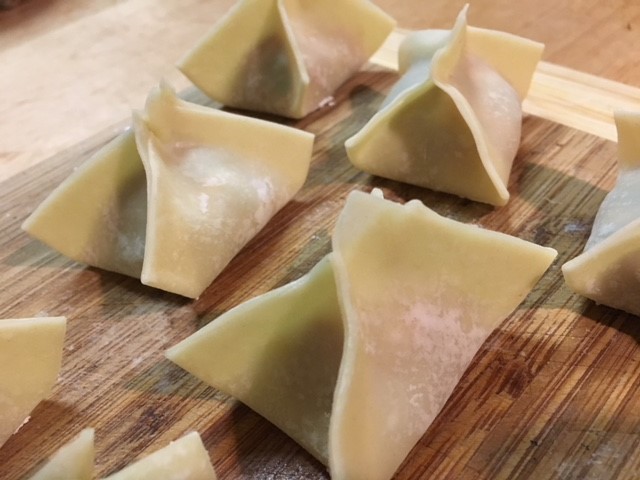
I planned to just finish making the filling entirely in the food processor, but I also didn't want to pulverize the pork and shrimp and lose that toothsome texture I was going for. Before adding the rest of the ingredients, I pulsed the food processor three or four times to roughly chop the pork and shrimp. I measured the rest of the ingredients right on top of the meat and pulsed a few more times to make sure everything was well incorporated, then scooped the filling out into a bowl. Before assembly, I set up a wonton making station with a small bowl of water, small pile of wonton wrappers, some filling and a plate with a thin dusting of corn starch on it to keep the wontons from sticking. One at a time, I put a small blob of filling in the middle of each wrapper, moistened all the edges with a tiny bit of water, then brought the corners of the wrapper up to make a little bundle. Its important to squeeze out any air as the wontons get sealed to prevent them from exploding while they cook. I pressed the moistened edges of the wrapper together to make sure it was well sealed before moving on to the next wonton.

I got about 10 wontons made, which was enough for dinner, then put the rest of the filling in the freezer. I took the wrappers out of their plastic container, wrapped them in a slightly damp paper towel, slipped them into a sandwich bag and put them in the freezer with the filling. By the time I was done making wontons, my broth was simmering gently, so I strained the broth I'd made from the shrimp shells into the pot, dropped the wontons in and let them cook gently until they floated, which only took about 5 minutes. The soup was fantastic with the veggies still kind of firm and the wonderful flavors of shrimp, pork and ginger in the wontons. The filling had that meaty chew that I was hoping for and it was a healthy and satisfying meal for a cold Sunday night.

As the weekend approached, I moved the filling and wrappers from the freezer to the fridge in anticipation of making dumplings by the following weekend. By the end of the week all the soup was gone and when I got home from work on Friday evening, I took the filling and wrappers out of the fridge.


I wanted to see how these dumplings performed both steamed and fried, so opted to steam half the dumplings and fry the other half. I put about an inch of water in a large pot, put my steamer basket in the bottom and laid several cabbage leaves on the steamer to keep the dumplings from sticking. In a small pot, I put about two inches of vegetable oil and turned both burners to medium high. As I was making the dumplings, I tried a few different shapes. For the steamed dumplings, I pinched the corners of the wrapper, then wrapped them around the side, leaving the filling exposed. For the fried dumplings, I made triangles, little bundles and tiny little cylinders that looked like mini egg rolls. I put the open-top dumplings on the steamer basked and put a lid on the pot. Two by two, I fried the other dumplings in the hot oil until they were crispy and dark brown. We enjoyed our dumplings with a little soy, hoisin sauce and sriracha. And they were a wonderful, tasty Friday night treat. There are lots of different types of fillings and cooking methods to experiment with, but this filling is a great all-purpose wonton and dumpling mixture that I know I'll make again and again.